
Bread & Butter ethical marketing statement
Marketing can be precise without being creepy. The people who visit your website aren't a dataset to be mined. They're potential customers, and they deserve to be treated the way you'd want to be treated yourself. This is our statement of what Bread & Butter will and won't do, what we mean by creepy, and why we think these choices make marketing more effective, not less.
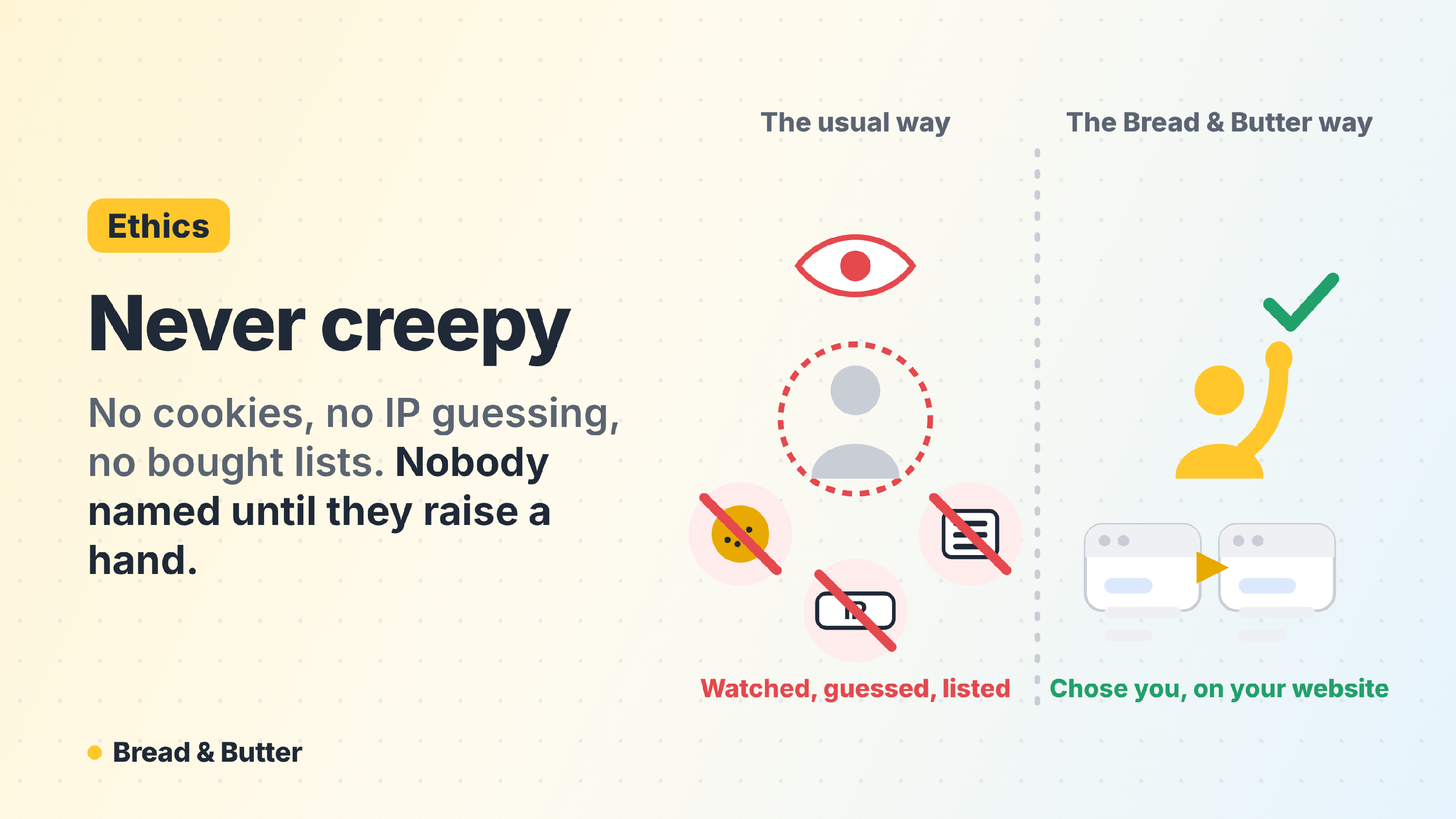
In short: Bread & Butter only sees what happens on your own website. We don't use third-party cookies, we don't follow people across the web, we never guess who someone is from their IP address, and we don't buy data to name your visitors. Nobody is named until they raise a hand on purpose: a form, a subscription, a purchase, or one click with an account they already have. We follow your visitors' consent choices, anyone can remove their personal information, bots never count as buyers, a person on your team sends every email, and your data is never sold. We think ethics and results go together: data that people give willingly, on your own website, is more accurate than data guessed about them, and a shorter list of people who chose you is worth more than a long list of guesses.
What we will and won't do
We only see what happens on your website. We don't drop third-party cookies, and we don't follow people across the web to see what they do elsewhere. If someone reads your pricing page four times and then fills in your contact form, that's the signal. What they did on other websites is none of our business, or yours.
We don't guess who someone is. No reverse IP lookups, and no buying data to put a name to an anonymous visitor. Until someone raises their hand, they're a journey and a Focused Score, not a name.
People choose to be known. A visitor becomes a lead when they do something on purpose: fill in one of your forms, subscribe, buy, or continue with an account they already have, such as Google, Microsoft, LinkedIn or Apple. That choice is their permission. At that moment, the visits they made before are joined to them, and research starts on who they are and the company behind them.
We respect consent, and the right to leave. If your website has a consent tool, Bread & Butter follows the choice visitors make there. Decline analytics or marketing, and nothing is stored on their device: they're counted in your totals, but they have no journey. Anyone can remove their personal information through the Privacy Manager. See How Bread & Butter helps you with privacy and consent and Privacy Manager.
Bots don't count as buyers. Automated traffic is now more than half the web. A bot scores 0, so it's never a Focused visitor or a lead. All Traffic still shows everything that reached your website, and the Bots & AI Crawlers report shows who they are.
Real people talk to real people. Bread & Butter drafts the first email from the research and the journey, but a person on your team reads it and sends it, from their own inbox.
Your data is yours. The journeys recorded on your website belong to you, and we never sell them. See Who owns the data I collect, and do you resell it?
What we mean by creepy
"Creepy" has a precise meaning for us. It's any marketing that knows something about a person that they never chose to share with you. These are the practices we've opted out of, and why.
Reverse IP lookup: spying on people's computers
A whole category of tools promises to tell you which companies, or even which people, are on your website right now, without anyone filling in a form. They do it by taking the visitor's IP address, the number that identifies their internet connection, and matching it against databases of who owns which addresses. Some go further and match the address to a named person through data bought from brokers.
Nobody visiting your website agreed to that. They came to read a page, and their connection was traced back to their office, their home or their phone. In practice it's a form of surveillance on people's computers, and it's increasingly treated that way by the law: in the Breyer case, the Court of Justice of the European Union ruled in 2016 that even a dynamic IP address is personal data when the website operator has a legal way to identify the person behind it, which puts this kind of lookup squarely under the GDPR.
It's also unreliable. With remote work and VPNs, the name that comes back is often the internet provider, a data centre or the coffee shop, not the buyer. See How is Bread & Butter different from "visitor identification" tools that track people without consent?
Bought lists: a database you can never leave
The other way to put names to visitors is to buy them. Data brokers assemble records on hundreds of millions of people from the websites they registered on, the forms they filled in, the purchases they made and public records, then sell those records on, over and over. Once your details are in one broker's database, they are copied and resold to others, and the emails and calls follow you for years.
Leaving is close to impossible. The US Federal Trade Commission described brokers' opt-outs as "largely invisible and incomplete" as far back as its 2014 report, and a 2025 investigation by WIRED found that many brokers had hidden their opt-out pages from search engines. A 2026 US Senate committee report tied four breaches of broker and credit data to about $20.9 billion in identity theft losses. We don't buy these lists, and we don't sell your visitors into them.
Following people across the web
Third-party cookies and tracking pixels record what a person does on other websites and bring it back to yours, so an ad for the thing they looked at follows them around the internet for weeks. Consumers name this as the most intrusive thing marketers do: in a 2026 survey of more than 4,800 people in the US and the UK, tracking behaviour across other websites or apps came top of the list of personalization tactics people find intrusive. Bread & Butter uses no third-party cookies and records nothing outside your own website.
Knowing too much, too precisely
Even data a person did share can be used in a way that feels like being watched. Gartner found that marketing content is 3.6 times more likely to be perceived as creepy when marketers use ten data points about a person instead of one, and that real-time location is one of the tactics people object to most. Bread & Butter uses the city a visit came from, the way any website analytics does, never a device's precise location, and the Intelligence Brief is written from what the person did on your website and what is public about their work, not from everything that can be found about them.
Faking the human
Chatbots that pretend to be people, and emails that pretend to be personal, are a quieter kind of creepy. Bread & Butter's Contact Intelligence promises your visitors a real person, not a chatbot, and your team keeps that promise: every email is read and sent by someone on your team.
What the research says
The case against creepy marketing isn't only ethical. The numbers say it doesn't work.
- 38% of customers will stop doing business with a company if they find its personalization efforts creepy, according to Gartner.
- Roughly half of personalized digital communications miss the mark because customers find them creepy, irrelevant or both, in Gartner's 2025 survey of 1,464 consumers and B2B buyers. Gartner's advice: build personalization on the data customers chose to share.
- 91% of consumers find at least one form of personalization intrusive, and three quarters say companies collect too much data, in a 2026 survey of more than 4,800 people in the US and UK.
- 81% of Americans are concerned about how companies use their data, 73% feel they have little or no control over it, and 67% say they understand little or nothing about what companies do with it, according to the Pew Research Center.
- 75% of consumers won't buy from a company they don't trust with their data, and half of the most privacy-aware consumers have already switched providers over privacy practices, in Cisco's 2024 survey of more than 2,600 people in 12 countries.
Why ethical is also effective
We don't think ethics and results pull in opposite directions.
The data is more accurate. Matching IP addresses to company databases worked better when everyone sat in an office. With remote work and VPNs, the name it returns is often the internet provider or the coffee shop, not the buyer. Data that people give you on your own website, when they choose to, doesn't have that problem.
The list is worth more. A long list of company names guessed from IP addresses is full of people who never asked to hear from you. A shorter list of people who raised their hand, each with their whole journey and real research behind them, is the one your sales team can act on.
The numbers can be trusted. With bots left out of Focused visitors and leads, your Focused Rate and your real conversion rate reflect people, not scripts.
It's built for where privacy law is going. The GDPR already treats IP addresses as personal data, about half of US states now have comprehensive privacy laws, and the rules only move in one direction. Building on first-party data and consent means you're not depending on practices that are being closed off.
Giving marketers the tools to compete
The biggest companies pay for data teams, enrichment platforms and analysts to understand who's on their website. Bread & Butter gives small marketing teams the same precision, and the tools to compete with them, without crossing lines their own customers would never accept.
Ethical, effective and precise. That's the standard we hold ourselves to.
Related
- Server-Side vs. Browser-Side Tracking: The Reliability and Ethics of Bread & Butter
- How is Bread & Butter different from "visitor identification" tools that track people without consent?
- How Bread & Butter helps you with privacy and consent
- Privacy Manager: how visitors can remove their personal information
- Who owns the data I collect, and do you resell it?
- What is Focused Score and how does it evaluate my traffic?
- Bots & AI Crawlers report
Sources
- Gartner, Marketers must focus on helping customers, April 2019: 38% will stop doing business over creepy personalization.
- Gartner, Marketing leaders can unlock commercial value with customer-shared data, June 2025: about half of personalized communications miss the mark.
- Customer Experience Dive, Nearly all consumers find some kind of personalization intrusive, September 2026: the 91% survey and Gartner's 3.6 times finding.
- Pew Research Center, Views of data privacy risks, personal data and digital privacy laws in America, October 2023.
- Cisco, How safe is our data? Consumers want to know, 2024 Consumer Privacy Survey.
- Federal Trade Commission, Data Brokers: A Call for Transparency and Accountability, May 2014.
- Forbes, Data brokers fuel scams: Senate report on billions of consumer losses, March 2026.
- IAPP, In Breyer decision, Europe's highest court rules on definition of personal data, October 2016 (CJEU case C-582/14).