
How SSO Can Improve Conversion Rates on Apps and Ecommerce Websites
Every extra field, password rule and confirmation email between a visitor and your product costs you sign-ups. Single sign-on (SSO) removes most of that friction. Instead of creating yet another account, a visitor clicks a button like "Continue with Google", confirms on a screen they already trust, and they're in. This article looks at what the research says about that friction in 2026, what companies saw when they removed it, and how to add SSO to your own app, store or member site.
In short: Passwords are one of the biggest leaks in any sign-up or checkout flow. In a 2025 FIDO Alliance survey, 48% of people said they had abandoned an online purchase because they forgot a password, and Baymard Institute finds that 18% of shoppers abandon checkout because the site made them create an account. Companies that add one-click sign-in report large gains: Reddit almost doubled conversion and Pinterest grew web sign-ups by 47% after adding Sign in with Google, according to Google's published case studies. Bread & Butter adds social login from Google, Microsoft, LinkedIn, Apple and others to your existing site without rebuilding your forms.
The password problem in 2026
People have more accounts than ever and less patience for them. NordPass found that the average person now holds around 168 passwords for personal accounts and another 87 for work. Its CTO, Tomas Smalakys, put it simply: "the amount of accounts that people hold gets higher every year."
That load shows up as lost business:
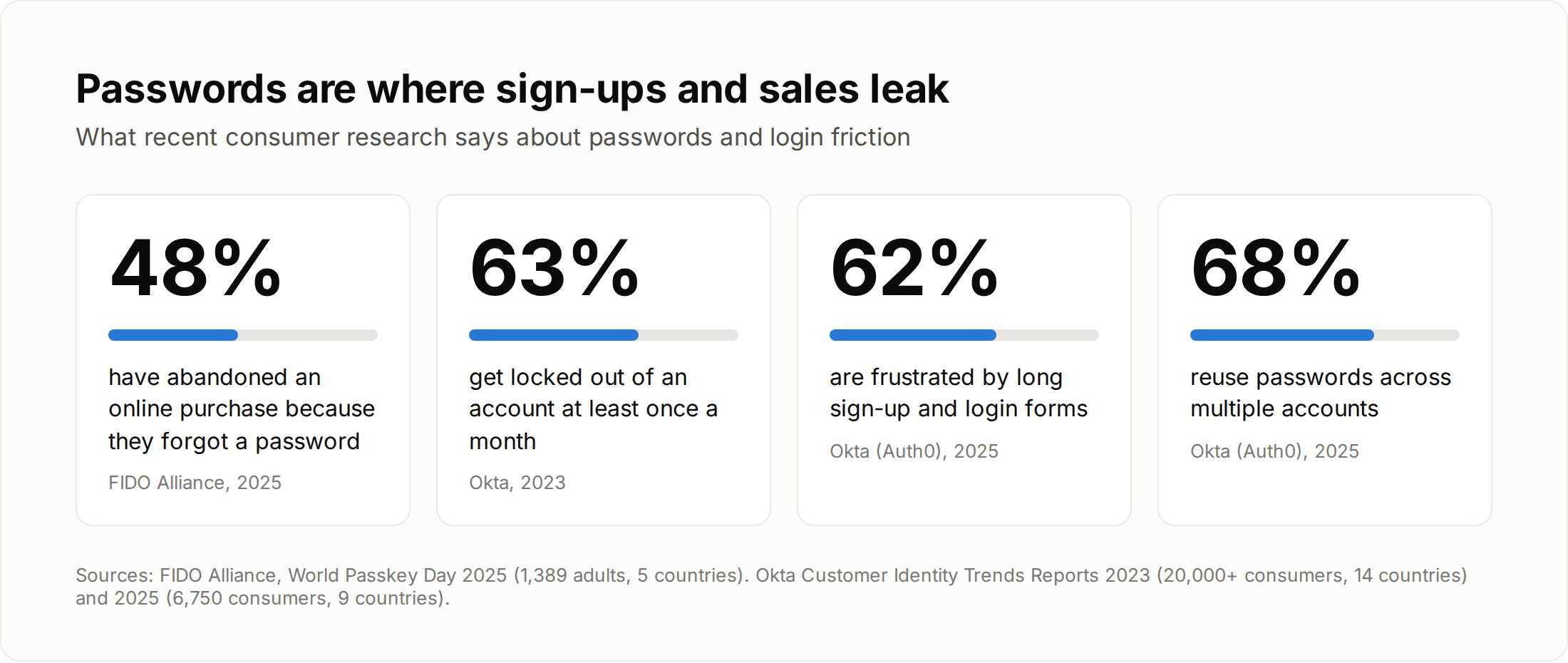
- Forgotten passwords stop purchases. 48% of people in the FIDO Alliance World Passkey Day 2025 survey had abandoned an online purchase because they forgot their password.
- People get locked out every month. In Okta's Customer Identity Trends Report 2023, a survey of more than 20,000 consumers in 14 countries, 63% said that at least once a month they can't get into an account because they forgot their username or password.
- Long forms frustrate most people. The Customer Identity Trends Report 2025 from Okta's Auth0, a survey of 6,750 consumers in nine countries, found that long sign-up and login forms frustrate 62% of users, and nearly a quarter of respondents abandon online purchases because of sign-up or login problems.
- Weak passwords are a security risk too. The same 2025 Okta report found that 68% of users reuse passwords across accounts, and the Verizon 2025 Data Breach Investigations Report names credential abuse as "still the most common vector" for breaches.
The flip side is just as clear. Nearly 60% of the people Okta surveyed in 2023 said they would be more likely to spend money if they were offered a simple, secure and frictionless login experience.
What happened when companies removed the password
Google publishes the results companies saw after adding Sign in with Google and One Tap. A few stand out:
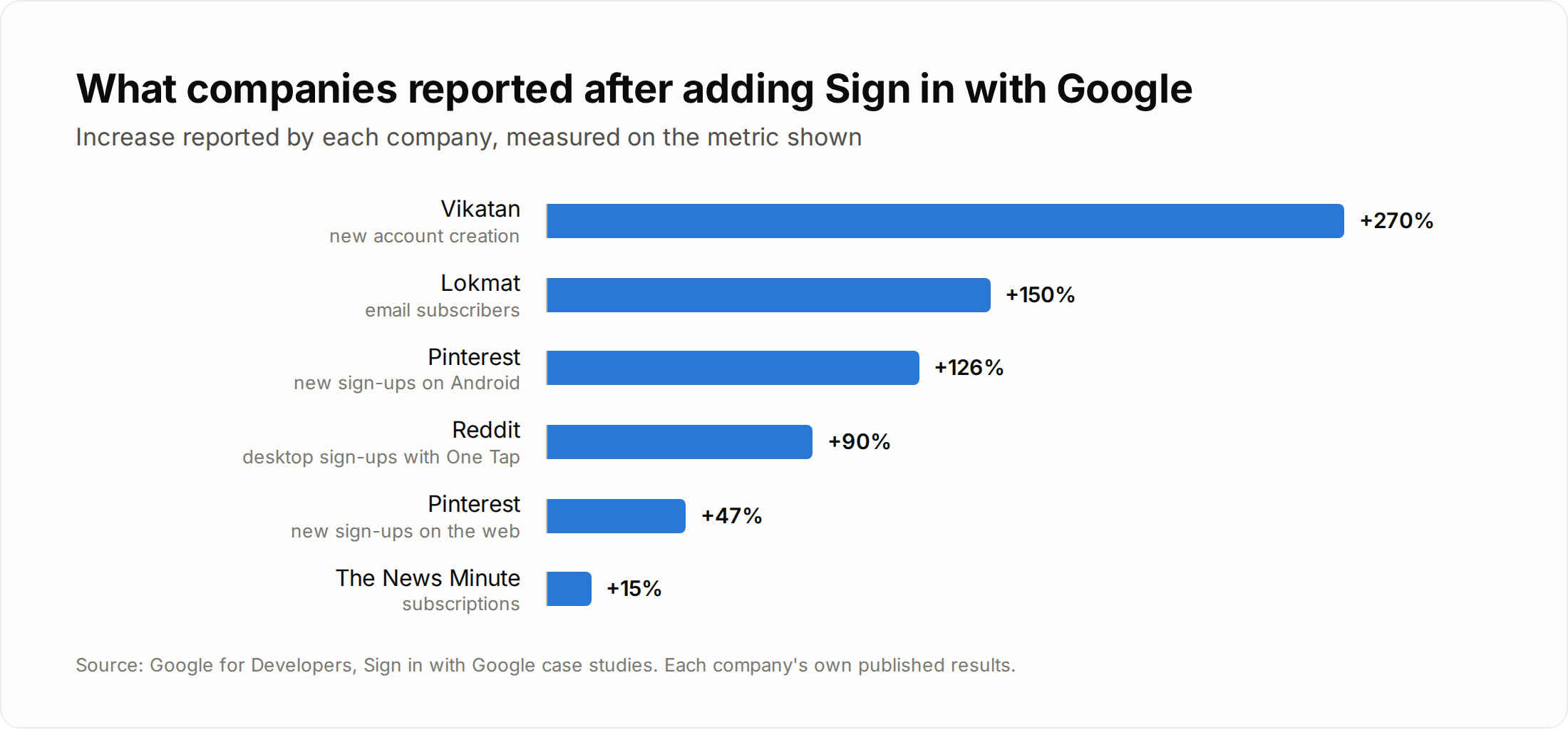
- Reddit was losing about 30% of new users at the username step. After adding the Sign in with Google button and One Tap together, conversion rose by almost 2X, and sign-ups from One Tap alone rose 90% on desktop. Yee Chen, Director of Product at Reddit, said the two options "significantly increased account creation and email coverage" by reducing friction in the sign-up flow. (Reddit case study)
- Pinterest saw new sign-ups rise 47% on the web and 126% on Android, and its users were twice as likely to choose One Tap over multi-step sign-in. Lena Ziskin, Growth Product Manager, described it as part of Pinterest's "vision of removing friction and making authentication intuitive". (Pinterest case study)
- eBay found returning users were twice as likely to sign in on desktop and mobile web. Mahendar Madhavan, Lead Product Manager, said it lets users "focus on what they really want to do, buy and sell." (eBay case study)
- Publishers and subscription sites saw similar gains: Lokmat reported a 150% increase in email subscribers and The News Minute a 15% increase in subscriptions. (Google case studies)
These are the companies' own results, published by Google, so treat them as examples of what's possible rather than a promise for every site. The pattern is consistent, though: when joining takes one click instead of a form and a password, more people finish.
Why SSO converts better
It borrows trust you haven't earned yet
A visitor who has just found your site has no reason to trust you with a new password. They already trust Google, Microsoft or LinkedIn. Seeing a familiar button makes a small or new site feel established, and the visitor stays on the provider's own screen for the part that feels risky.
It's faster
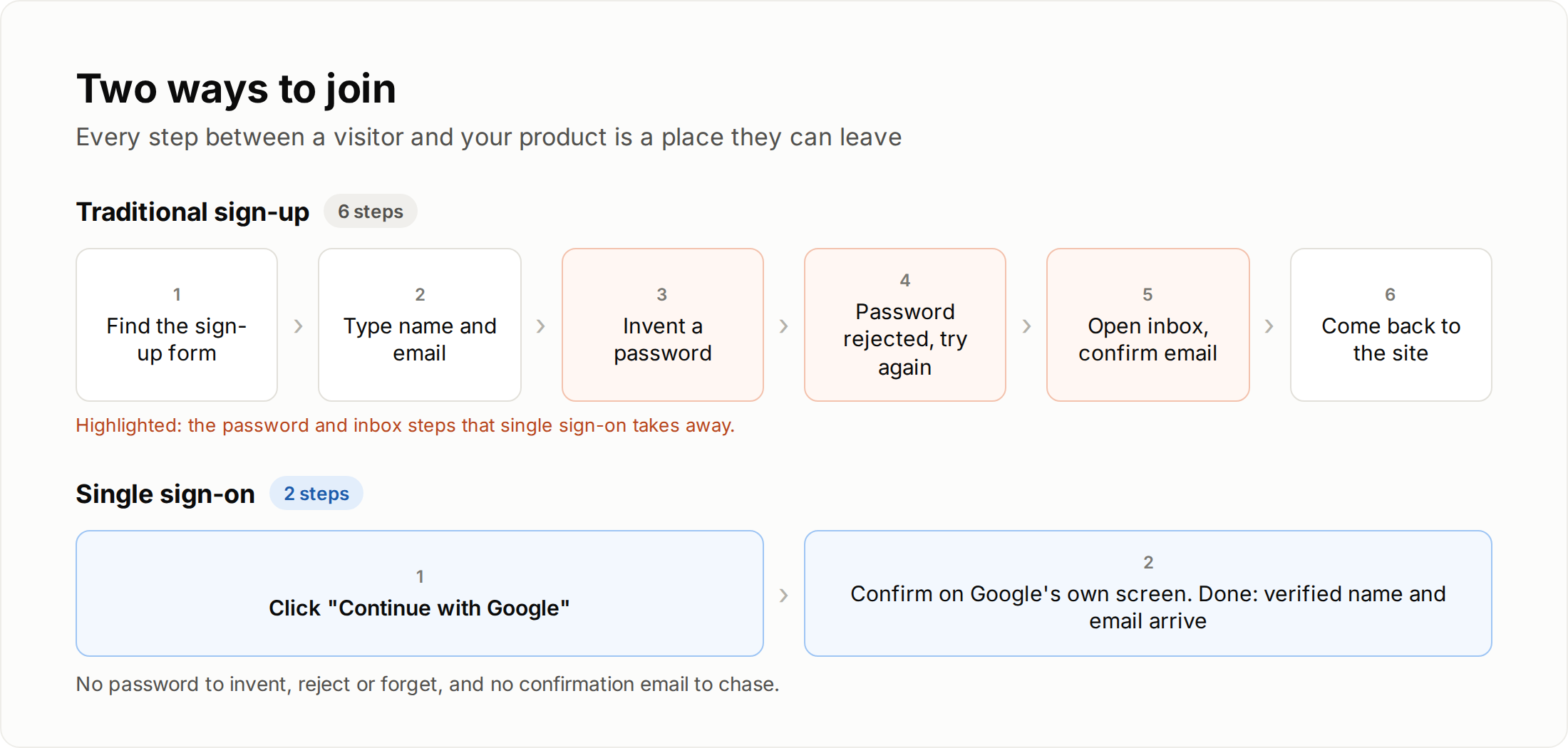
What used to be a form, a password with complexity rules and a confirmation email becomes one click. There's no moment where a password gets rejected for missing a symbol, and no inbox to check before the visitor can carry on.
It keeps people coming back
Returning is just as easy as joining. Visitors don't hit a password prompt they can't answer, which is exactly where the forgotten-password abandonment in the research above happens. For member sites and apps, that means more people come back and fewer get stuck at the door.
It gives you better data
Every address that arrives through Google or Microsoft has already been verified by the provider, so there are no typos, made-up addresses or dead inboxes. That's cleaner data for your CRM and your email campaigns.
It cuts support and security work
You stop handling password resets because you don't hold passwords at all. That also means there's no password database to protect, which matters when credential abuse is the most common way into a system.
SSO on ecommerce sites
For online stores, the checkout is where friction costs the most. Baymard Institute puts the average documented cart abandonment rate at 70.22%, across 50 studies. Among shoppers who abandon during checkout, 18% leave because the site wanted them to create an account and 17% because the checkout was too long or complicated. Baymard estimates that better checkout design alone can raise conversion by 35.26%.
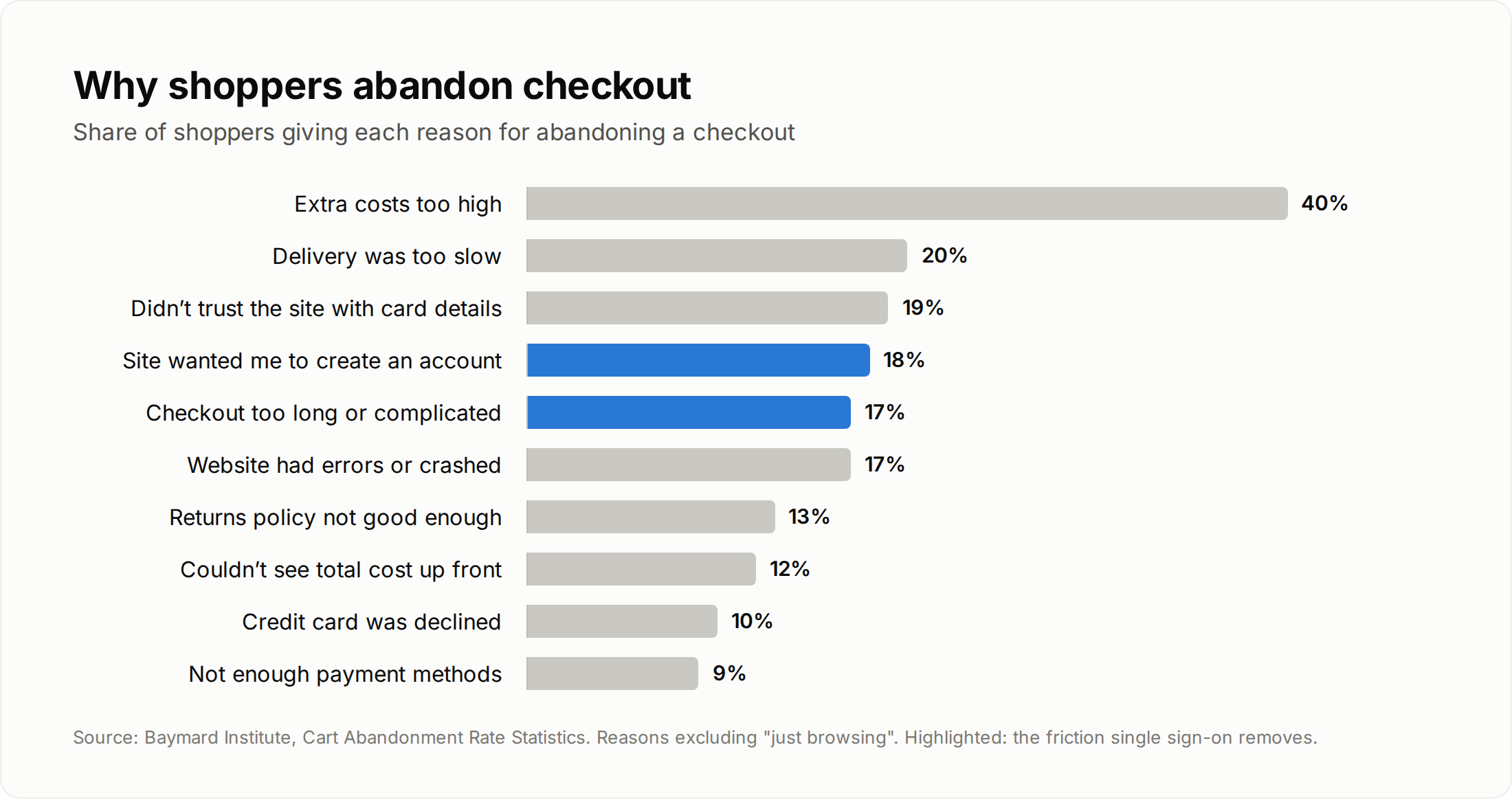
One-click sign-in tackles both of those reasons at once. The shopper doesn't have to invent a password, their name and email address arrive already filled in, and a returning customer is recognized without digging for credentials. Keep guest checkout available as well. SSO works best as the fastest option, not the only one.
Offer more than one option
Different audiences live in different accounts. B2B buyers often work in Google Workspace or Microsoft 365, professionals may prefer LinkedIn, and many iPhone users reach for Apple. Offer the providers your audience actually uses, and always keep an email option for people who'd rather type an address. Put your strongest option first.
Add SSO to your website with Bread & Butter
Bread & Butter adds social login to your existing website without rebuilding your forms or writing an integration.
- Choose your providers. In Bread & Butter, open Settings, then the Global Conversion Methods tab, and turn on the providers you want under Social Logins: Google, Microsoft, LinkedIn, Apple, Facebook and more. Enterprise options such as Okta and OneLogin are available too. Drag your preferred buttons to the top.
- Put them where people join. Add the Continue with widget on top of your existing forms, gate premium content with a content gate, grow your list with the Subscription Booster, keep members recognized with the Account Widget, or replace the WordPress sign-in page. The Subscription Booster syncs new members to MemberPress, WooCommerce and your CRM.
- Keep an email option. Visitors who prefer to type an address still can, and Bread & Butter checks it in real time so dead and disposable addresses are caught before they reach your list.
- Let us maintain it. Providers change their requirements over time. Bread & Butter keeps each connection up to date, so nothing breaks at a bad moment.
Every visitor who joins this way becomes an engaged lead with a verified email address. The User Journey recorded since their first visit is attached to their profile, so you can see which pages and campaigns brought them in, whichever provider they chose.
Related
- Does using social logins instead of a simple email field decrease my conversion quantity?
- Google (Gmail + Google Suite)
- How does Bread & Butter eliminate spam without making me rebuild my existing web forms?
- What types of content gates do you offer, and when should I use them?
- Subscription Booster
Sources
- FIDO Alliance, Consumer Password and Passkey Trends: World Passkey Day 2025. SurveyMonkey survey of 1,389 adults in the US, UK, China, South Korea and Japan, April 2025.
- Baymard Institute, Cart Abandonment Rate Statistics
- Google for Developers, Sign in with Google case studies, including Reddit, Pinterest and eBay
- Okta, Customer Identity Trends Report 2023. More than 20,000 consumers in 14 countries.
- Okta (Auth0), Customer Identity Trends Report 2025. 6,750 consumers in nine countries.
- NordPass, People have around 170 passwords on average. 1,509 NordPass users, March 2024.
- Verizon, 2025 Data Breach Investigations Report, Executive Summary