
Does Bread & Butter tell us which campaigns are worth investing in?
Yes. Every verified lead is linked back to its original campaign, UTM source, keyword and landing page, so you can see which channels generate high intent leads rather than just high traffic.
That linkage is what turns a reporting question into a buying question. Most analytics tools can tell you which campaign produced the most sessions. Bread & Butter ties every visit from an ad to the person it brought, including the visits your UTM tags missed, and keeps it on the same record as everything else that person does on your website. From there, each campaign and keyword is measured by the people worth having, not the clicks: a Focused CPC and a Focused CPM on every one, so a cheap click that brings nobody shows up straight away. Then each of your Google Ads campaigns and keywords gets a verdict, so the answer is a short list rather than a spreadsheet.
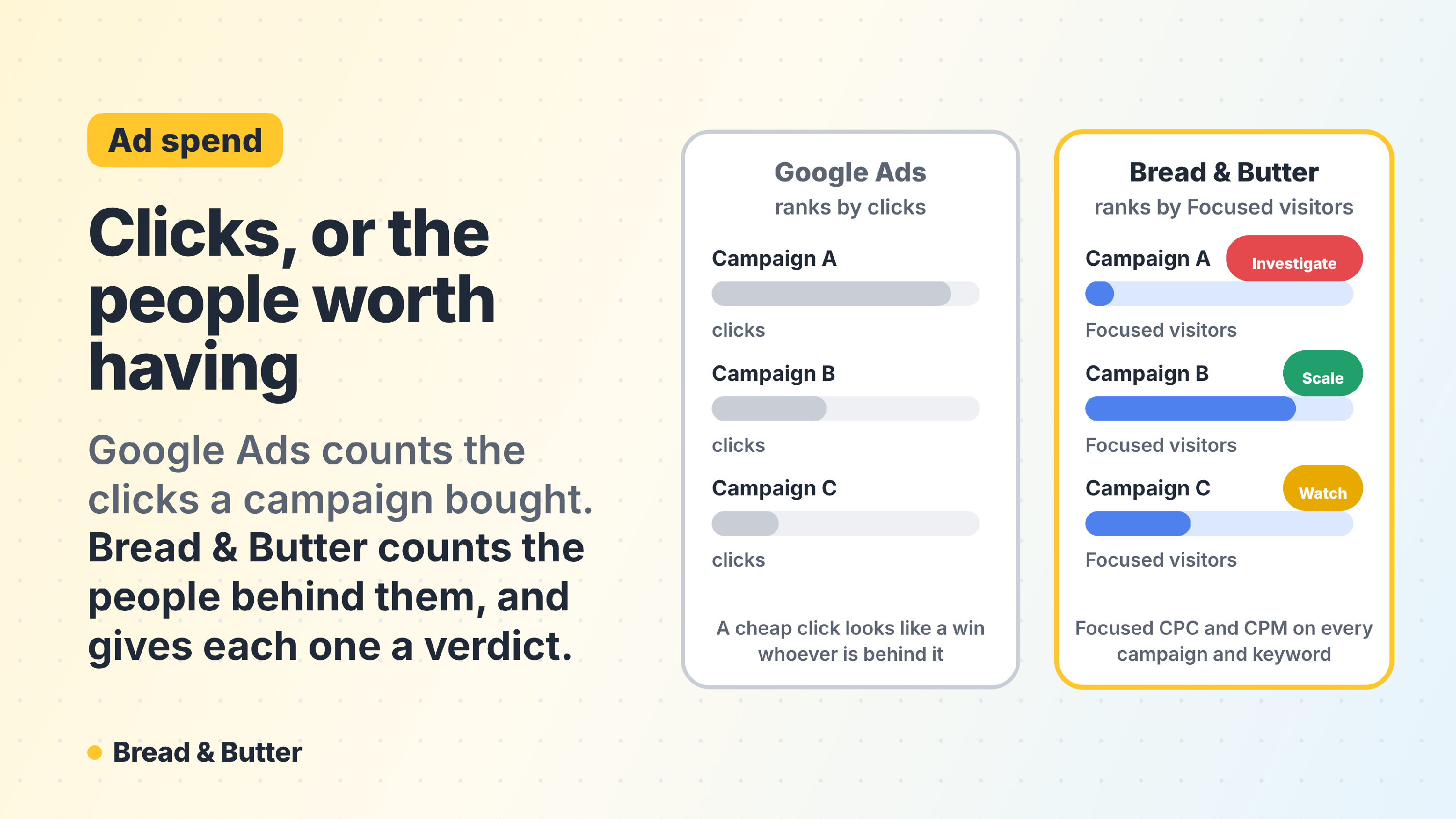
In short: Yes. Bread & Butter connects every verified lead to the campaign, UTM source, keyword and landing page that produced it, and with Google Ads connected it places every ad visit by Google's own record of the click, even when the UTM tags are wrong. Each Google Ads campaign, ad group and keyword is judged against your own account's paid Focused Rate and marked Scale or Investigate once Bread & Butter is 90% confident, or Watch when the data never gets there. Everything is measured in Focused visitors, Engaged Leads and Won/Closed deals instead of clicks, and set against the conversions Google reports. Google Ads connects directly; traffic from LinkedIn, Meta and Reddit is attributed and scored the same way through your UTM tags. The tool points you at the campaigns that deserve your attention and your money, but it never spends the money for you, and it takes three to six months of running before the picture is stable enough to bet a budget on.
What "worth investing in" means here
A campaign is worth investing in when it brings you people who behave like buyers, not when it brings you volume. Bread & Butter measures that in three layers, and each one is a stricter test than the one before it.
- Focused visitors are the real humans the campaign brought to your site, with the bots, scrapers, instant flybys and internal colleagues stripped out. This is the honest version of your traffic number.
- Engaged Leads are the Focused visitors who went on to give you an email address and engage properly. This is the honest version of your lead number.
- Won/Closed deals are the ones that turned into revenue. This is the number that settles arguments.
A campaign that looks strong on clicks and collapses at the Focused layer was never buying you customers. A campaign with modest volume that holds up all the way to Won/Closed is the one you should be feeding. Because every lead carries its campaign, UTM source, keyword and landing page with it, you can follow any of these numbers back to the exact ad and search term that produced it.
With Google Ads connected, that trail doesn't depend on your UTM tags being right. Bread & Butter matches each Google Ads visit to Google's own record of the click and places it under its campaign, ad group and keyword, so a visit from an ad with missing or copied tags still counts toward the campaign that paid for it. The Ads Spend report shows how many visits needed that match, and what to fix in Google Ads.
Scale, Watch and Investigate
Rather than leaving you to interpret those numbers alone, Bread & Butter gives each Google Ads campaign, ad group and keyword a verdict. Each one is judged against your own account's paid Focused Rate, the share of your paid visitors who are Focused, not against other advertisers.
- Scale means Bread & Butter is 90% confident it does better than your paid average: it brings you more qualified visitors for the money.
- Watch means the data never reached 90% confidence either way. Real performance, but the kind that usually moves with tighter targeting, better creative or a stronger landing page.
- Investigate means Bread & Butter is 90% confident it does worse: money going out with fewer real buyers coming back.
Investigate is deliberately worded as a prompt to look rather than an instruction to act. It is the right verdict for a very low performing campaign that may still be worth understanding. Some of those campaigns should be cut. Others are brand terms holding your ground against a competitor, or feeders into a long consideration cycle, or perfectly good ads pointed at a broken page. The report tells you where to spend your attention first; what you do with the budget is your call.
Because the verdicts wait for 90% confidence, a keyword isn't marked on one lucky or unlucky week. Until then it shows its status: Calibrating, with the date a verdict is expected, or Learning · waiting for Google while Google's bid strategy for the campaign is still learning. Keywords with too little traffic to judge alone are judged with their ad group or campaign, and every verdict says how many days of data it rests on. After a verdict, the item goes into a second round that counts only what happened afterwards, so you see whether the change you made worked.
Where the Google Ads numbers come from
Google Ads connects to Bread & Butter directly. Once it is connected, your spend is pulled in automatically and set against the leads it produced, so you get cost per Engaged Lead, cost per Won/Closed, Focused CPC (the cost per Focused visitor) and Focused CPM (the cost per 1,000 Focused visitors) rather than cost per click. Every campaign and keyword carries its own Focused CPC and Focused CPM, which is how a campaign with cheap clicks and a low Focused Rate turns out to cost more per serious visitor than one with expensive clicks and a high one.
It also puts Google's own conversion count next to the people who raised their hand. Google counts every conversion action set up in the account, more than once per person and including view-throughs, and Smart Bidding buys more of whatever it counts. Engaged Leads are people, counted once, carried through to the deals you mark Won/Closed. Where the two are far apart, Google is crediting a campaign with conversions that never became real leads.
The Insights tab shows six campaigns and six keywords on rotation, two of each verdict. The Ads Spend report, which you run in your AI assistant, has every campaign and keyword with its numbers and verdict, up to three budget shifts at the same total spend, and a timeline of what each change you made in Google Ads did. See Ads Spend report.
Traffic from LinkedIn, Meta and Reddit is attributed and scored alongside everything else as long as your UTM parameters are set up properly, so its Focused performance is directly comparable with your Google Ads campaigns. The cost side for those platforms comes from each platform.
Where the budget should go
Because every ad visit sits on the person's record, the picture doesn't reset each month. The same record that tells you who is ready to buy this week is the one that, over time, shows which campaigns and keywords keep bringing the people who become Engaged Leads and Won/Closed deals, and which keep bringing clicks and nobody. That is what the verdicts and the Ads Spend report are built on: not a month of clicks, but every visit from every ad, tied to the person it brought and to what they did next.
What it does not do
It does not make the decision for you and it does not move budget on your behalf. Bread & Butter only reads your Google Ads account and never changes it, and there is no setting that reallocates spend automatically. The verdicts are an opinion about where your money is working, offered with the evidence attached, and a marketer who knows the business context will always overrule them sometimes.
It is also not an instant answer. The first verdicts arrive on day 15 at the latest, and often sooner, because the 90 days of Google Ads visits from before you connected count. But expect three to six months before your team reliably knows what to scale, what to watch and what to investigate. You need enough qualified visitors across enough campaigns for the verdicts to settle, and you need a run of deals marked Won/Closed so that scoring is calibrated against the buyers you actually want rather than the ones you assumed you wanted. Treat the first weeks as a baseline, not a verdict.
The payoff, once you are through that, is usually one of two things: a smaller budget, because you stopped paying for traffic no buyer was behind, or the same budget buying far more qualified visitors than it used to.
Putting it to work
This article answers whether Bread & Butter can tell you which campaigns deserve your money. For the step by step version, including how to read the tabs, filter by campaign, keyword, lead stage and Focused Score, and how to connect Google Ads so the cost figures appear, see How do I use the Attribution report to optimize my marketing budget?
Related
- Ads Spend report
- Connect Google Ads
- How do I use the Attribution report to optimize my marketing budget?
- What is the primary purpose of the Attribution Report?
- What is Accurate Attribution and Lead Intelligence
- How to Set up UTM to Maximize Visibility into Focused High Intent Traffic
- Understanding the Focused Rate and Focused CPM for paid traffic
- What is the Focused CPM?
- How do Lead Stages work in Bread & Butter, and why does marking Won/Closed matter?
- What is Focused Score and how does it evaluate my traffic?
- Why can Bread & Butter track a lead's full journey for years, when CRMs and cookie-based tools lose the trail after a few months?