
The Intelligence Brief: Living Context in the Tools Your Team Already Uses
A rep about to write an email has two bad options. Spend twenty minutes researching the prospect across LinkedIn, Google and news sites, or send something generic based on whatever the CRM captured three months ago. The first does not scale; the second does not convert.
The Intelligence Brief removes the choice. It is a single payload that combines deep enrichment, full attribution and AI-generated sales context, delivered straight into the CRM your team already works in. No extra tabs, no manual research, no opening Bread & Butter to get the value of Bread & Butter.
In short: the Intelligence Brief is a single, continuously updating payload of enrichment, attribution and AI-generated sales context, delivered straight into the CRM your team already uses. It refreshes automatically every time a prospect returns to your site, and the research behind it is re-run on each return, so reps are always working from current context instead of a stale form submission. It is available natively in Salesforce, HubSpot and Pipedrive with no manual mapping required, plus Slack, Zapier and Webhooks. Need the full raw session history behind it instead? That is the Intelligence Stream.
The Problem With Stagnant CRM Records
Most CRMs are static databases. A lead fills out a form, a record is created, and then it sits there while the person's professional life carries on without it.
They get promoted. Their company raises a round. They come back to your website four more times and read your pricing page twice. None of that reaches the record, so your rep is working from a snapshot of a moment that has already passed.
The cost is not just a weaker email. It is missed timing. A prospect who returns to your enterprise pricing page three times in a week is telling you something specific, and if that signal never leaves Bread & Butter, nobody acts on it.
What Makes the Brief Different
It is one payload, not five integrations. More than fifty data points covering the person, their company, their attribution, generated outreach context and the current Nurture draft arrive together in a single push. There is no stitching together an enrichment API, an intent tool and a data provider, and no brittle middleware to maintain when one of them changes.
It is living, not a one-time handoff. Every time that prospect returns to your website and their session closes, we regenerate the Brief and push the updated version. Their Focused Score moves, their attribution updates, their journey summary reflects what they just did. And the research is re-run, not just the on-site data: a new role, a move to another company, fresh company news, something happening where they are. The refreshed Brief leads with what changed since last time rather than repeating the whole profile, so the record in your CRM is always current and the update is always readable.
It requires no workflow change. Your reps do not learn a new tool. The context sits in the fields next to their compose window, in the system they already open every morning.
What's Inside
Every conversion sends the basic contact record to your CRM: first name, last name, email address and a link back to the profile. The Brief is the layer on top of that record. It has two kinds of field, all at the same level: the structural data your operations team needs for routing and scoring, and the written context your reps need for outreach. It also carries the latest Nurture AI draft for the lead, so the email is already written by the time the record updates.
The foundation: enrichment and attribution
User and company profiles. Role, LinkedIn profile, an AI-generated summary of their professional background, plus firmographics on their employer including industry, headcount, year founded and location.
First and last attribution. Complete UTM parameters, referrer, geography and device data for both their very first visit and the session that just closed. This is what lets you see not only how someone found you, but what brought them back.
Focused Score. The 1 to 10 intent score, recalculated as their behaviour changes.
The written context
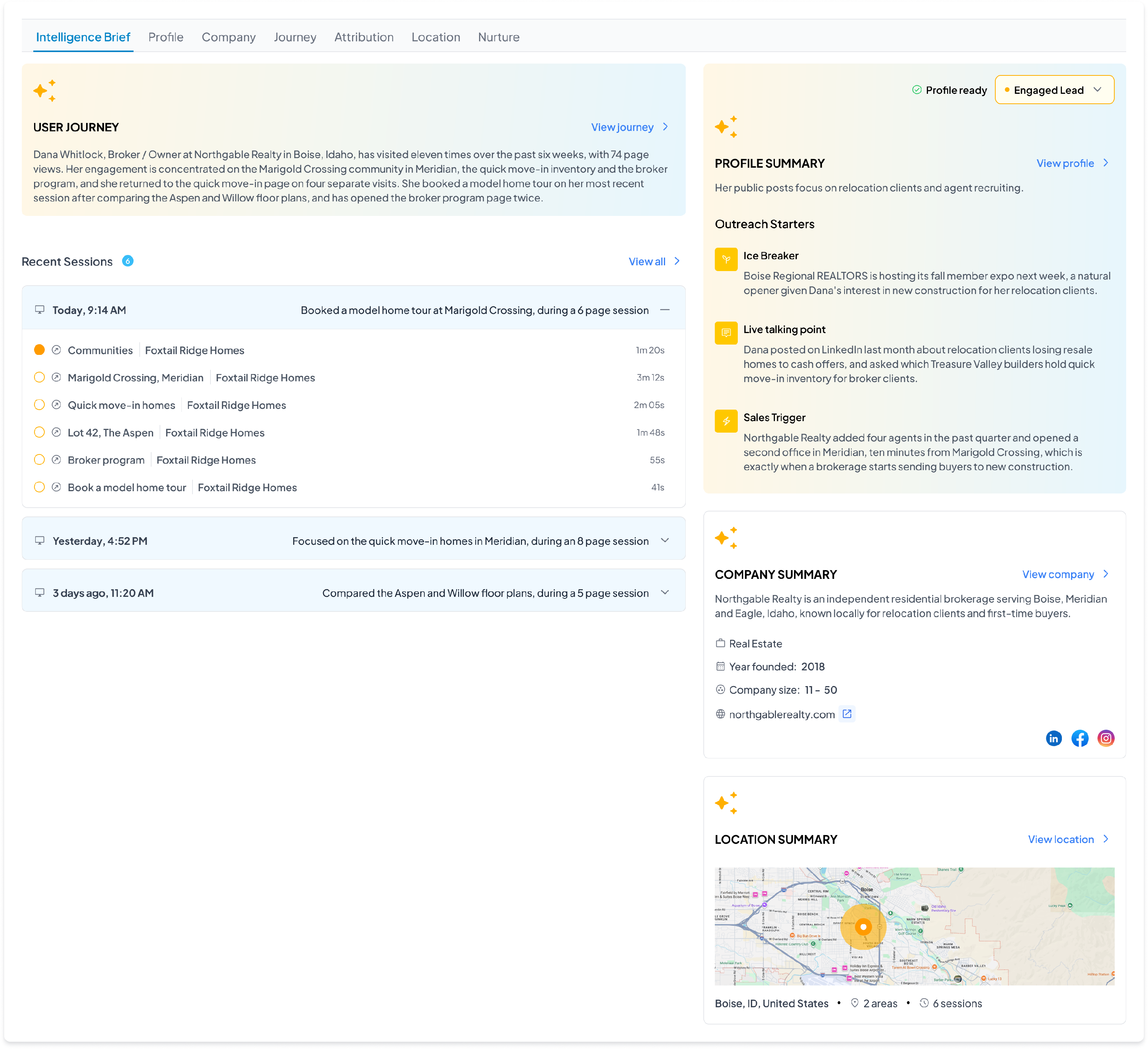
Operations teams want structure. Reps want something they can read in ten seconds and act on. The second half of the Brief is six written fields designed to be scanned rather than parsed.
They arrive in this order:
Latest session summary. One sentence on what they just did. Where they entered, how long they stayed, where they left.
User journey summary. A fuller paragraph covering their entire history with you: how many times they have returned, what they keep coming back to, and how their focus has shifted over time. This is where a genuine buying signal usually shows itself, because the change matters more than any single visit.
Attribution summary. How they originally found you, and what keeps bringing them back, written in plain language rather than raw UTM strings.
Real-time icebreaker. A hyper-local, time-sensitive reference based on where the prospect is: a local event, local news, something happening in their city this week. Something to open a conversation like a person rather than a sequence.
Live talking point. Recent promotions, career milestones, or professional connections you share.
Compelling sales trigger. Company-level intelligence: a funding round, a product launch, an acquisition, a new award, a press mention. The reason to reach out now rather than next quarter.
Connecting the Brief to Your CRM
Because the whole thing arrives as one organised payload, mapping it takes no developer effort for a standard setup. You enable and manage it from the Automation section of your dashboard.
Native integrations. We integrate directly with Salesforce, HubSpot and Pipedrive. Connect your account and the Brief populates automatically into the standard fields, no manual mapping required.
Slack. The Brief can also be delivered as a formatted message in Slack, so a rep sees the full context the moment a high-intent lead converts, without opening anything.
Zapier and Webhooks. If you use a different CRM or a proprietary internal system, push the entire Brief anywhere the moment a lead's context updates.
You control which leads are included by attaching a saved filter to the automation. Many teams send the Brief only for leads above a certain Focused Score, so their CRM stays clean and their reps only see what deserves attention.
If You Need More Than a Summary
The Brief is deliberately a summary. That is what makes it useful in a CRM field and readable in ten seconds.
If your team needs the underlying record instead, every session, every page, engagement scores for each one, and attribution for each individual visit, that is the Intelligence Stream. It is built for data warehouses and BI tools rather than CRMs, and it is available through Zapier and Webhooks.
Most teams use both: the Brief where reps work, the Stream where analysts work.
Why This Matters
Personalisation at scale is one of the hardest problems in B2B sales. Without timely context, reps sound like bots, because functionally they are working like bots, sending sequences based on data that stopped being true months ago.
The Brief means your revenue team has the latest intelligence the second they go to write, not the version that was accurate when the form was submitted. That removes the research time, gives reps a reason to write that is true today, and lets them move while intent is still high.