
Why is a Focused visitor more accurate than Google Analytics' engagement rate?
Google Analytics 4 calls a visit "engaged" when it passes one fixed test, and that test is the same for every website on the internet. Bread & Butter calls a visitor Focused when their behaviour ranks among the most engaged on your own website, judged by a model built around your site. The two numbers can look alike on a report, but they measure different things, and only one of them adapts to how your site is built.
In short: Google Analytics counts a session as engaged if it lasts more than 10 seconds, or loads two pages, or records a key event. Any one of the three is enough, and the rule is the same for a one-page landing page and a thousand-page store. A Focused visitor is a person, not a session, scored from 1 to 10 against the other visitors on your own website, using everything they do across every visit, including heatmap engagement. Visitors scoring 6 or higher are Focused. Nobody has to read a heatmap or tune a threshold, and the model keeps sharpening as your traffic grows and as you mark deals Won/Closed.
How Google Analytics decides a session is engaged
The rule. In Google Analytics 4, a session counts as engaged if it does any one of these: lasts longer than 10 seconds, has a key event (what Google used to call a conversion), or has two or more page or screen views. Your engagement rate is engaged sessions divided by all sessions, and bounce rate is the opposite.
It's an "or", not an "and". One condition is enough. A visit that loads two pages counts, however quickly it happens. A visit that stays on one page for 11 seconds counts too.
It's the same rule for everyone. The 10-second timer can be changed in your Google Analytics settings, but by default the test is identical for a B2B software site, a recipe blog and an RV dealer directory. It doesn't know what your pages are for.
Where a flat rule breaks
One-page websites. On a site where the information, the pricing and the form all sit on one long page, nobody ever loads a second page. The two-page test never fires, so engagement comes down to the timer alone, and a visitor who reads every section looks the same as one who left the tab open for 11 seconds.
Sites built to be clicked through. On a directory, a store or a site with short pages, loading two pages is easy and says very little. Engagement rate looks high whether or not anyone was seriously looking.
Sessions, not people. Google Analytics judges each visit on its own. Someone who comes back three times over two weeks, reading a little more each time, is three separate sessions, not one increasingly serious person.
The result. Engagement rate rises and falls with how your site happens to be built as much as with the quality of the people visiting it. That makes it hard to compare two sites, and hard to trust when you redesign your own.
How Bread & Butter decides a visitor is Focused
Compared against your own visitors. Focused Score doesn't use a universal rule. It ranks each visitor against the other visitors on your website, so a 10 on your site means "among the most engaged people I get", not "passed a test set for everyone". Visitors with any engagement are spread evenly across the 1 to 10 scale, and a score of 6 or higher makes a visitor Focused.
Built around your site. The model learns what engagement looks like on your pages and how your site is laid out. A long single page and a site of short pages are each judged on their own terms.
Everything they do, across every visit. The score is per person and builds over all of their visits: the pages they read and in what order, how they engaged with each page, including heatmap engagement, and whether they came back. Converting, and the profile built when an email address arrives, add to the picture.
No heatmaps to read. Heatmaps are useful, but only if someone has time to study them page by page. Bread & Butter reads that engagement for every visitor automatically and turns it into one score, so the most engaged people surface on their own in your Focused Tab.
It keeps learning. Scoring starts on the first visit, and the ranking sharpens as traffic builds and the model sees more of how people use your pages. Every deal you mark Won/Closed teaches it what your real buyers looked like before they bought.
What this means for your numbers
Focused Ratio instead of engagement rate. Your Focused Ratio is Focused visitors divided by all visitors. Because it's measured against your own traffic, a change in it reflects a change in who is arriving, not a change in your page layout. You can compare it against the Focused Index, the benchmark across all Bread & Butter customers, once your first 15 days of calibration are complete.
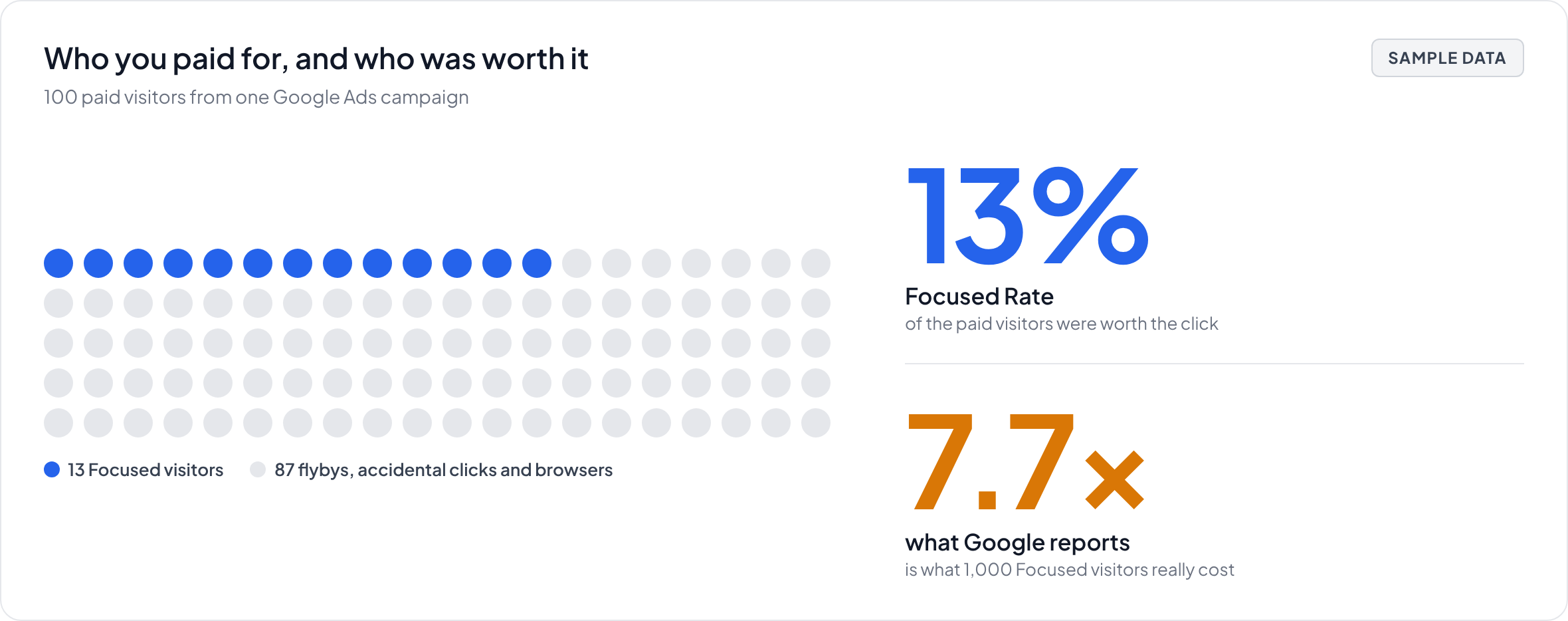
Focused Rate for paid traffic. With Google Ads connected, the same measure applied to a campaign or keyword is its Focused Rate: the share of visitors from that campaign or keyword who became Focused.
What a serious visitor costs. Divide your cost per click by the Focused Rate and you get your Focused CPC, what each Focused visitor really costs you. Divide your cost per 1,000 impressions by it and you get your Focused CPM. A campaign with cheap clicks and a low Focused Rate can cost far more per serious visitor than one with expensive clicks and a high one.
Keep both if you like. Google Analytics is still useful for sessions, page views and traffic sources. Use the Focused Ratio when the question is whether the people arriving are worth your time.
Related
- What is Focused Score and how does it evaluate my traffic?
- Understanding the Focused Index
- What is the Focused Tab and how is it different from Engaged Leads?
- What is my real conversion rate, and why is it higher than my analytics says?
- Why are my standard traffic KPIs so "off" in 2026, and how does the All Traffic Tab fit into this?
- Understanding the Focused Rate and Focused CPM for paid traffic
- Google Ads