
Why your website analytics undercount, and what to measure instead
Who this is for: marketers and founders who have noticed their analytics, ad platform and CRM don't agree, and want to know which number to trust.
What you'll learn: why every analytics tool misses some visitors and miscounts others, what changed in browsers recently, how to see the gap on your own website, and why the number that matters is the quality of your traffic, not the total.
Your analytics says one thing, Google Ads says another, and the CRM says a third. None of them is lying. They're all counting a web that has become harder to count.
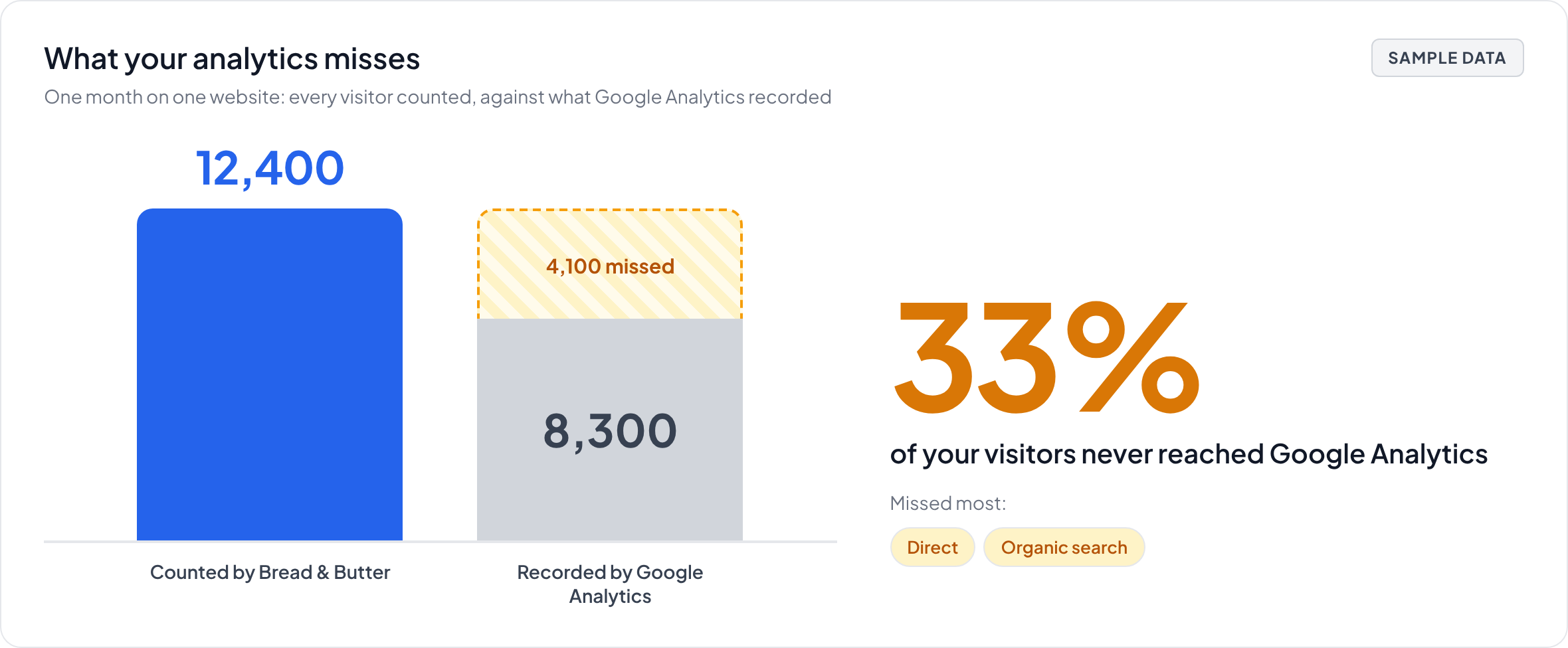
In short: Four things distort website numbers in 2026. Ad blockers and privacy tools stop some tracking scripts from loading, so those visits aren't counted. Safari strips tracking parameters from some links and, from iOS 26, adds fingerprinting protection to all browsing, so some visits lose their source. Consent banners mean visitors who decline aren't tracked in the usual way. And bots, which now make up more than half of web traffic, inflate the numbers the other way. No tool counts everything. If your website runs Google Analytics, the Bread & Butter Old School Website Analytics report opens with the gap measured on your own traffic: the share of your visitors Google Analytics never recorded. Beyond that, stop judging your site on raw totals and judge it on how many serious visitors you get, where they came from, and whether they became customers. That's what Bread & Butter measures.
What makes the numbers wrong
Ad blockers and privacy tools
GWI's data for the second quarter of 2025 puts ad blocker use at 29.5% of internet users worldwide. Many blockers stop analytics and advertising scripts, not just ads. When the script doesn't load, the visit isn't counted.
Safari
Apple keeps adding privacy protections to Safari:
- Link Tracking Protection removes tracking parameters from links opened from Mail and Messages and in Private Browsing. A visit from a tagged link can arrive without the tag that says where it came from.
- Advanced fingerprinting protection is on for all browsing from iOS 26, not only in private windows. It makes devices harder to tell apart.
- Third-party cookies have been blocked by default in Safari for years.
The result is visits that arrive as "direct" when they weren't, and returning visitors counted as new.
Consent banners
In regions that require consent, visitors who decline aren't tracked the way visitors who accept are. Depending on how your banner and tools are set up, those visits may be modelled, partly counted or not counted at all.
Bots
The problem runs the other way too. Imperva's 2025 Bad Bot Report found that automated traffic made up 51% of all web traffic in 2024, and 37% was malicious bots. Some are filtered by analytics tools; many aren't. They inflate sessions, bounce rates and, sometimes, form submissions.
AI assistants
Some visits from ChatGPT, Perplexity and other assistants arrive with a clear referrer; others arrive as direct, for example when someone copies a link from an answer. Every analytics tool sees the same thing.
So which number do you trust?
None of them for the total. All of them for the trend, if you understand what each one misses.
The more useful question isn't "how many visitors did we get?" It's "how many of them were serious, where did they come from, and did they buy?" That question is less sensitive to what the browser strips out, because it's about people, not sessions.
See the gap on your own website
You don't have to take the industry figures on trust. If your website runs Google Analytics, the Bread & Butter Old School Website Analytics report opens with a card called What Google Analytics can't see, measured on your own traffic.
It works like this. Bread & Butter counts every visitor with its own script and keeps the data first-party, with bots removed. Google's tag gives each browser it records a client ID, kept in a cookie, and Bread & Butter reads that ID on every page view. A visitor counts as missed by Google Analytics when none of their visits in the period carried one. The card shows the share of your visitors Google Analytics missed as one number, the visitors Bread & Butter counted against the visitors Google Analytics recorded, month by month, the share missed from each traffic source, and the same gap for visits and pageviews.
Two things to know when you read it. The ID proves Google's tag ran in that browser; it doesn't prove Google Analytics kept every hit, so consent settings can keep more people out than the card shows. And the gap is rarely the same for every source: on the websites we have measured, Direct visitors are missed far more often than visitors from ads, so Google Analytics doesn't only undercount, it tilts the comparison between your channels.
To run it, ask your AI assistant for the Old School Website Analytics report for your website and the period you want. Every other card in that report counts the people Google Analytics missed.
What Bread & Butter measures instead
Serious visitors, not raw sessions. Focused Score ranks every visitor 1 to 10 on what they did on your site. Visitors scoring 6 or higher, and everyone who converts, appear on your Focused Tab. Bots and instant bounces don't get there. See What is Focused Score and how does it evaluate my traffic?
A ratio, not a total. Your Focused Ratio is the share of your traffic that behaves like a serious visitor. It's a better health check than sessions, because it isn't inflated by bots and bounces, and you can compare it against the Focused Index across the Bread & Butter network. See What is the Focused Index, and what is a healthy Focused Ratio?
Sources ranked by quality. The Attribution Report shows each source, campaign and keyword against the quality of the visitors it sent, and, once you mark deals Won/Closed, against the ones that became customers. See What is the primary purpose of the Attribution Report?
One journey per person. When a visitor tells you who they are, by filling in a form, subscribing or using a social login, their visits are joined into one journey, so a person who came back five times through three channels isn't five strangers.
Your real conversion rate. Measured against serious visitors rather than every session, your conversion rate usually looks very different. See What is my real conversion rate, and why is it higher than my analytics says?
What to do
- Keep your UTM tags. Tag every campaign link. Some tags will be stripped, but most won't, and untagged links have no chance. For Google Ads, connect your account as well: Bread & Butter then matches every ad visit to Google's own record of the click, so it lands under the right campaign and keyword even when the tags were stripped or wrong. See How to set up UTM to maximize visibility into high-intent traffic
- Measure the gap on your own website. Run the Old School Website Analytics report once, and keep the "What Google Analytics can't see" card in mind every time you read a Google Analytics number.
- Stop comparing totals across tools. Each counts differently. Compare trends within a tool instead.
- Judge campaigns on serious visitors and customers, not clicks or sessions.
- Mark your wins. Every deal marked Won/Closed makes the scoring and the source rankings more accurate.
Common questions
Does Bread & Butter count visitors my analytics misses?
Yes, and it shows you how many. Blockers and privacy settings affect every tracking tool to some degree, but Bread & Butter counts visitors with its own script and keeps the data first-party, so it records many of the people Google's tag doesn't. The Old School Website Analytics report opens with the share of your visitors Google Analytics never recorded, measured on your own website. See "See the gap on your own website" above.
Why do Google Ads and my analytics show different conversions?
They count differently: different attribution windows, different rules for which click gets the credit, and different gaps from blockers and consent. Neither is wrong; they're answering different questions. Google Ads also counts every conversion action set up in the account, more than once per person and including view-throughs, and Smart Bidding buys more of whatever it counts. Bread & Butter counts Engaged Leads, people counted once, and the Ads Spend report puts the two side by side. See Ads Spend report.
Should I remove Google Analytics?
No need. Use it for traffic trends, and let Bread & Butter tell you how much of your traffic it never saw. Use Bread & Butter to see which visitors were serious and which sources bring customers.
Related
- What is Focused Score and how does it evaluate my traffic?
- What is the Focused Index, and what is a healthy Focused Ratio?
- What is my real conversion rate, and why is it higher than my analytics says?
- How to set up UTM to maximize visibility into high-intent traffic
- What is the primary purpose of the Attribution Report?
Sources
- GWI data via Backlinko, Ad Blocker Usage and Demographic Statistics (29.5% of internet users, Q2 2025)
- Apple, Apple announces powerful new privacy and security features (Link Tracking Protection), June 2023
- 9to5Mac, With iOS 26, Safari will counter one of the web's most invasive tracking methods, July 2025
- Imperva, 2025 Bad Bot Report (51% of web traffic automated in 2024; 37% malicious bots)